
Five Societal Trends Quietly Reshaping Business in 2018


I recently revisited a presentation I developed several years ago on five major business and societal trends. What surprised me wasn’t how much the world had changed since then. It was how relevant these trends still are.
Here's a executive briefing of these trends:
The technologies have advanced. The language has changed. New generations have entered the workforce. AI has accelerated nearly every industry. Yet many of the forces reshaping business today are the same ones that were already building momentum years ago.
Those five forces are:
The hyper-aging society
Mass urbanization
The millennial mindset
The sharing economy
The continued rise of emerging markets
These trends don’t operate independently. They overlap, reinforce one another, and create second-order effects that can be easy to miss.
Here is how I see each one affecting business today.
1. The Hyper-Aging Society
People are living longer, remaining active longer, and working later in life.
That sounds like a demographic observation, but it has enormous implications for business.

An aging population changes healthcare demand, workforce planning, retirement models, product design, housing, transportation, financial services, and consumer behavior. It also changes how companies think about institutional knowledge.
Organizations are simultaneously facing two challenges:
Experienced workers are reaching traditional retirement age.
Many industries cannot find enough skilled people to replace them.
This creates a strong case for rethinking the traditional career lifecycle.
Companies will need more flexible work arrangements, better knowledge-transfer systems, and new ways for experienced professionals to contribute without remaining in conventional full-time roles.
This could include advisory positions, fractional leadership, mentoring networks, project-based work, and AI systems that help preserve institutional knowledge.
The market opportunity is equally significant.
Older consumers are not a single, uniform segment. Many are healthier, more technically capable, and more economically active than previous generations. They want products and services that support independence, mobility, wellness, connection, and quality of life.
The companies that succeed will avoid treating aging as a limitation. They will design for longevity as an expanding market.
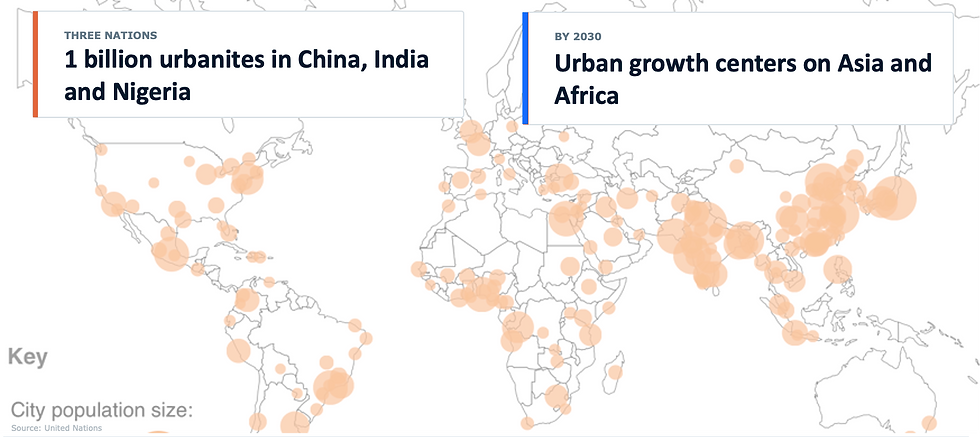
2. Mass Urbanization
Cities continue to attract people, capital, infrastructure, and opportunity.
As populations concentrate in urban areas, cities become more than places where people live. They become connected operating environments.

Transportation, energy, housing, healthcare, public safety, education, logistics, communications, and commerce all intersect within the same physical space. That creates complexity, but it also creates enormous opportunity.
Cities need better ways to manage congestion, energy consumption, waste, public infrastructure, and access to essential services. At the same time, companies gain access to concentrated markets of customers, partners, and talent.
The next generation of urban innovation will depend on how effectively organizations connect physical infrastructure with digital intelligence.
We can already see this happening through:
Connected transportation systems
Distributed and renewable energy
Smart buildings
Digitally coordinated public services
Autonomous and electric mobility
Localized manufacturing and fulfillment
Real-time infrastructure monitoring
The opportunity is not simply to make cities “smart.” That term has become so broad that it often loses meaning. The real opportunity is to make cities more adaptive.
An adaptive city can sense changing conditions, coordinate resources, and respond quickly. The same principle applies to businesses operating within it.
Organizations need to understand cities as dynamic ecosystems rather than collections of disconnected markets.
3. The Millennial Mindset
Much has been written about millennials, often through oversimplified stereotypes.
The more important story is that many behaviors once associated primarily with millennials have become normal expectations across generations.
People expect digital convenience. They expect transparency. They want flexibility in how they work, buy, communicate, and access services. They are comfortable comparing traditional companies with technology companies, even when those companies come from completely different industries.
A consumer does not compare a bank only with another bank. They compare the experience with Amazon, Apple, or whatever digital service last made their life easier.
An employee does not compare their workplace only with a competitor. They compare it with every flexible, collaborative, technology-enabled environment they have experienced.
This shift has raised the standard for every organization.
Millennials also helped accelerate a movement away from rigid command-and-control structures toward more collaborative models of work. Today, that shift continues through remote work, distributed teams, the creator economy, independent consulting, digital entrepreneurship, and AI-assisted productivity. The broader trend is about agency.
People want greater control over their time, careers, experiences, and relationships with organizations.
Companies that continue designing around institutional convenience will struggle. Companies that design around individual agency will have a much stronger chance of earning loyalty.
4. Digital Ecosystems
The sharing economy was initially associated with companies such as Airbnb and Uber. But its lasting impact goes much deeper than individual platforms.

It changed how we think about ownership, access, and underused capacity. A physical asset, specialized skill, dataset, distribution network, manufacturing capability, or customer community can now become part of a broader ecosystem.
This has created new markets by making previously inaccessible resources available on demand.
The larger business shift is from owning every capability to orchestrating capabilities across a network.

Companies increasingly compete through ecosystems of suppliers, developers, creators, logistics providers, technology platforms, and specialized partners. The strength of the business depends not only on what the company owns, but also on what it can access and coordinate.
AI will accelerate this trend.
Intelligent agents will increasingly help organizations find capabilities, evaluate providers, negotiate services, coordinate work, and manage transactions across these ecosystems.
That creates tremendous opportunity, but it also introduces questions about trust, accountability, quality, data ownership, and control.
Access may be replacing ownership in many markets. Responsibility, however, cannot be outsourced so easily.
The companies that lead in ecosystem-based business models will need strong governance alongside seamless participation.
5. Emerging Markets Continuously Adjust
The term “emerging market” can make these economies sound as if they are all following the same predictable development path. They are not.
Markets mature at different rates. Population centers shift. Infrastructure develops unevenly. Consumer expectations change quickly. Political, technological, and economic conditions can alter the opportunity in a relatively short period.
A market that appears too risky today may become strategically important tomorrow. A market that once looked like a long-term growth engine may slow as wages, demographics, or regulations change.
This makes emerging-market strategy much more complicated than simply identifying countries with strong GDP growth.
Companies need to understand the local ecosystem:
Who are the customers?
How do they access products and services?
Which infrastructure constraints shape the market?
Who are the trusted local partners?
What role does government play?
Which business models fit local conditions?
How quickly are consumer expectations changing?
One of the biggest mistakes companies make is assuming that a successful model from a mature market can be transferred directly into an emerging one.
Emerging markets often require different products, pricing models, distribution channels, partnerships, and operating assumptions.
The organizations that succeed will resist the temptation to copy and paste. They will design for the realities of each market.
These Trends Are Converging
The most important point is that these forces do not move independently.
An aging population influences workforce availability and healthcare demand. Urbanization concentrates that demand in cities. Digital expectations reshape how people access services. Platform-based business models connect previously fragmented capabilities. Emerging markets create entirely new centers of consumption, talent, and innovation.
Now add AI to the equation.
AI can help organizations understand these changes, personalize services, coordinate ecosystems, preserve knowledge, and identify new opportunities. It can also amplify bias, accelerate poor decisions, and make already complicated systems more difficult to govern.
The question for leaders is not which single trend will affect their organization. Several of them already are.
The better questions are:
Where are these trends intersecting?
Which customer or workforce expectations are changing?
What assumptions about our business no longer hold?
Where could a new market or business model emerge?
What will happen if we continue operating as we do today?
Trends rarely arrive as one dramatic event. They build gradually until the old assumptions stop working.
By that point, the organizations that paid attention early have usually moved ahead.
The future often looks sudden only to the people who were not watching it develop.

Comments