
AI Isn't the Strategy. Business Impact Is.


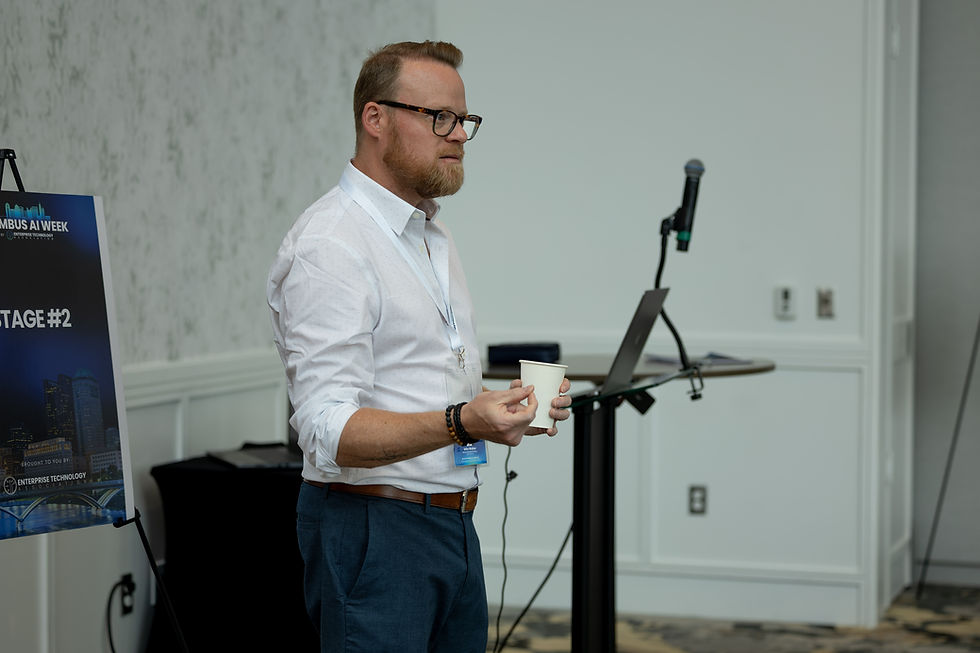
A huge THANK YOU to everyone who joined me for my keynote, “The AI Reckoning: Five Survival Imperatives Every Technologist Must Master Before It’s Too Late” along with The Circuit and the Momentum Developer Conference for asking me to keynote their event.
What an incredible day at Momentum 2026! It was an incredible experience sharing my perspectives with hundreds of business and technology leaders about where AI is heading and what organizations need to do NOW to prepare for what's next.
Throughout my career, including my time leading technology innovation research at Gartner and advising Fortune 500 organizations at Microsoft, I've witnessed multiple waves of technological disruption.
Cloud computing fundamentally changed how we consume technology. Mobile computing redefined how we interact with information. The Internet of Things connected the physical and digital worlds.
Artificial intelligence is different.
AI doesn't simply introduce another technology for organizations to adopt. It challenges our assumptions about how businesses should be designed, how work should be performed, how decisions should be made, and ultimately, how value should be created.
Yet there's a significant disconnect between the promise of AI and the results organizations are realizing.
McKinsey's State of AI in 2025 research found that nearly two-thirds of surveyed organizations had not begun scaling AI across the enterprise. Only 39% reported enterprise-level EBIT impact from AI, despite widespread experimentation and adoption.
Let's really think about that. Organizations are investing extraordinary amounts of capital, talent, and executive attention into AI. Yet a majority of surveyed organizations have not demonstrated enterprise-level earnings impact.
One of my key messages was:
The problem isn't necessarily the technology. It's how we're approaching transformation.

Too many organizations are applying AI to existing business processes rather than asking whether those processes should exist in their current form. They're optimizing yesterday's operating models with tomorrow's technology.
And that's precisely why I believe the next phase of AI adoption will look fundamentally different.
During my keynote, I outlined five trends that I believe will shape enterprise competitiveness over the next three to five years. These aren't isolated technology predictions. They're five interconnected forces that business leaders must understand to make better strategic decisions.
Trend 1: Frontier Company Evolution
From AI-Enabled Organizations to AI-Native Enterprises
For decades, enterprise transformation largely followed a predictable pattern. Organizations introduced new technology, integrated it with existing systems, trained employees, and incrementally improved business processes.
We're witnessing the emergence of a fundamentally different organizational model: the Frontier Company. Microsoft introduced this concept in its 2025 Work Trend Index, describing organizations designed around intelligence on demand, human-agent collaboration, and AI-enabled operating models.
The research, which included 31,000 workers across 31 countries, revealed that:
82% of business leaders viewed 2025 as a pivotal year to rethink key elements of their strategy and operations.
81% expected AI agents to be moderately or extensively integrated into their organization's AI strategy within 12–18 months.
These are measures of executive expectations, not evidence that organizations have completed the transformation. Nevertheless, they indicate an important shift in leadership priorities.
The evolution of the enterprise
I see organizations progressing through four increasingly sophisticated stages.
Stage 1: AI-Assisted Enterprise
Employees use AI tools to improve individual productivity.
Examples include drafting documents, summarizing meetings, generating presentations, and analyzing information.
The organizational structure remains largely unchanged.
Stage 2: AI-Enabled Enterprise
AI becomes embedded into business applications and workflows.
Organizations begin integrating AI into customer service, software development, finance, operations, and supply chain management.
Productivity improves, but humans remain responsible for initiating and coordinating most activities.
Stage 3: Agentic Enterprise
AI agents begin coordinating activities, executing multistep workflows, interacting with enterprise systems, and making bounded operational decisions.
Human employees increasingly supervise outcomes, manage exceptions, and exercise judgment.
The fundamental unit of productivity begins shifting from an individual performing a task to a human-agent team delivering an outcome.
Stage 4: Frontier Company
Organizations redesign their operating models around a combination of human expertise, machine intelligence, and autonomous execution. Rather than simply automating tasks, they rethink entire value streams.
Organizational boundaries become more fluid. Decision-making becomes more distributed. Intelligence is embedded directly into business operations.
Importantly, these stages are a strategic maturity model, not an inevitable sequence every business must follow.
The real transformation: Rethinking work
Consider a pharmaceutical manufacturing organization.
Traditionally, investigating a manufacturing deviation might require employees to manually gather information from manufacturing execution systems, laboratory systems, quality management platforms, maintenance records, and historical investigations.
AI could initially help summarize that information. But imagine a fundamentally different workflow. An intelligent system detects an abnormal manufacturing condition, correlates relevant operational information, identifies potential contributing factors, and prepares a structured investigation package. A qualified employee evaluates the evidence, determines the appropriate action, and approves the next steps.
The objective is not to remove human accountability. It's to allow human expertise to focus on decisions requiring judgment while intelligence handles much of the information gathering and analysis. This is the distinction between AI-assisted work and AI-native operations.
Trend #2: Enterprise AI Architecture
Moving From Disconnected AI Experiments to an Enterprise Intelligence Foundation
Enterprise architecture has evolved through several major technological eras.
Client-server computing introduced distributed applications.
Service-oriented architecture enabled systems integration.
Cloud computing transformed infrastructure consumption.
Microservices and APIs changed application development.
Now, AI is introducing another architectural transformation. And I believe this one will be just as consequential.
The problem is AI fragmentation
Walk into almost any large enterprise today and you'll likely find multiple AI initiatives operating independently.
Marketing may be experimenting with generative AI.
Finance might be building forecasting agents.
IT is evaluating development copilots.
Operations is testing predictive analytics.
Meanwhile, business units are independently procuring AI-enabled applications. Individually, these projects may demonstrate value. Collectively, they can create a fragmented technology environment with duplicated capabilities, inconsistent governance, disconnected data, and rising operational costs.
This becomes particularly problematic as organizations move from conversational AI toward autonomous agents that interact with enterprise systems.
You cannot scale enterprise intelligence effectively on a foundation of disconnected experiments.
Many times this leads to dead-ends, wasted time, and wasted money in a land called POC Purgatory...

The emergence of Enterprise AI Operating Architecture
I believe organizations need to evolve beyond traditional application-centric architecture toward an integrated Enterprise AI Operating Architecture. This doesn't mean replacing existing enterprise systems, yet.
It means establishing a common architectural foundation for integrating intelligence across them.
That foundation requires several interconnected capabilities.

1. Enterprise data and context
AI systems need access to trusted, relevant, timely information. But enterprise intelligence requires more than connecting a language model to a database. It requires understanding the business meaning, relationships, provenance, and authorization boundaries associated with that information.
A manufacturing asset, customer, product, supplier, or financial transaction must have consistent meaning across enterprise systems.
2. Intelligence and model services
Organizations need capabilities to select, deploy, evaluate, monitor, and manage multiple AI models. Different workloads require different approaches. Some problems benefit from frontier models. Others may be better served by small language models, specialized predictive models, deterministic algorithms, or combinations of these technologies.
Model selection should reflect performance requirements, economics, latency, privacy, and business risk.
3. Agent orchestration and execution
As organizations introduce autonomous agents, they need a systematic way to coordinate tasks, invoke tools, manage state, enforce permissions, and supervise execution.
Without orchestration and control, agents risk becoming another collection of disconnected applications.
4. Enterprise integration
AI must interact with existing enterprise technologies. ERP, CRM, MES, PLM, supply chain management, financial systems, and operational technology platforms remain essential systems of record and execution.
The opportunity is to introduce an intelligence layer that can reason across those systems and coordinate activities without compromising transactional integrity.
5. Governance, security, and observability
Organizations must be able to determine what AI systems are doing, what information they're accessing, why actions were taken, and whether results comply with enterprise policies.
This becomes increasingly important as autonomy increases.
6. Business outcomes and experience
Ultimately, enterprise architecture exists to enable business capabilities.
AI systems should be designed around measurable outcomes, not simply technical functionality.
Architecture should enable transformation, not become transformation itself.
Trend 3: Business Continuity for Intelligence Access
When AI Becomes Mission-Critical, Intelligence Availability Becomes a Business Risk
Here's a question I posed during my keynote:
What happens when your business becomes dependent on AI intelligence—and that intelligence suddenly becomes unavailable?
For most organizations, business continuity planning has historically focused on physical facilities, networks, applications, infrastructure, and access to data.
Those concerns remain critical. But we're approaching a world in which the availability of intelligence itself becomes a business dependency.
Imagine an organization where AI agents coordinate logistics, optimize production, support customer interactions, monitor security threats, and assist operational decision-making.
Now imagine losing access to the models, infrastructure, or services powering those capabilities. This introduces a new category of enterprise operational risk.
Intelligence is becoming critical infrastructure
The International Energy Agency projects that global data center electricity consumption will more than double to approximately 945 terawatt-hours by 2030, with AI representing a major driver of that growth.
That's slightly more than Japan's current annual electricity consumption.
This illustrates an important reality.
AI may feel like software, but the intelligence it delivers depends on an enormous physical infrastructure ecosystem.
That ecosystem includes semiconductor manufacturing, advanced computing hardware, electricity generation, transmission infrastructure, cooling systems, data centers, telecommunications, and specialized engineering talent.
And much of that infrastructure is subject to significant supply constraints, geopolitical dependencies, and long development cycles.
Three constraints shaping intelligence availability
I believe three forces deserve particular executive attention.

Power. Advanced AI infrastructure requires substantial electricity and cooling capacity. Energy availability and transmission constraints can influence where AI infrastructure can be deployed and how quickly capacity can expand.
Labor. Building and operating AI infrastructure requires specialized expertise across engineering, construction, electrical systems, computing, cybersecurity, and operations. Skills shortages can create deployment bottlenecks even when capital is available.
Politics. Geopolitical competition increasingly influences semiconductor availability, international technology transfers, infrastructure investment, and data sovereignty requirements. Access to intelligence is therefore becoming a question of national policy as well as enterprise technology strategy.
Sneak Peek at another related trend: Enterprise Sovereign AI
This brings us to a concept I believe will become increasingly important: Enterprise Sovereign AI.
Sovereignty isn't necessarily about building your own data center or training your own language model. It's about maintaining sufficient control over the intelligence capabilities your organization depends on.
In my view, a sovereign AI strategy should address six essential dimensions:
Data ownership and control. The enterprise maintains appropriate authority over sensitive information, its access, residency, and use.
Compute availability. Critical workloads have reliable access to sufficient computing capacity.
Model optionality. The organization can evaluate and adopt alternative AI models rather than depending unnecessarily on a single provider.
Infrastructure flexibility. Workloads can operate across appropriate cloud, private, hybrid, or edge environments where technically and economically justified.
End-to-end security. Zero-trust principles govern identities, information access, agent permissions, and system interactions.
Regulatory compliance. AI capabilities operate within applicable legal, contractual, and industry requirements.
Sovereignty is not absolute independence. It is the deliberate management of dependencies, control, and operational risk.
A new dimension of business continuity planning
Organizations should begin incorporating intelligence availability into their business continuity and disaster recovery strategies.
For critical AI-enabled business processes, leaders need to understand:
What happens if a model provider becomes unavailable?
Can workloads be redirected to alternative models?
What happens when compute capacity becomes constrained?
Which processes can continue with reduced intelligence capabilities?
When must operations revert to human-directed or deterministic procedures?
What recovery times are acceptable?
Traditional recovery time objectives and recovery point objectives remain useful, but they should be supplemented with measures of acceptable model degradation, inference capacity, and safe operational fallback.
The more intelligence becomes embedded into your business, the more important it becomes to ensure that intelligence remains available, reliable, and under appropriate control.
Trend 4: Physical AI & Spatial Intelligence
Artificial Intelligence Is Leaving the Screen and Entering the Physical World

Much of the AI revolution has focused on digital information. Language models interpret text. Generative AI creates content. AI agents interact with software.
But some of the most consequential transformations will occur when intelligence begins interacting directly with the physical world.
From understanding language to understanding reality
Traditional language models learn statistical relationships within enormous volumes of digital information.
Physical AI systems face a different challenge. They must interpret environments, recognize objects, understand spatial relationships, predict physical interactions, and select actions under real-world constraints.
Consider a robot operating inside a manufacturing facility. It needs to do more than recognize an object.
It may need to understand:
Where the object is located in three-dimensional space.
How it relates to surrounding equipment.
Whether it can be safely manipulated.
What happens when force is applied.
How the environment may change.
Whether a proposed action creates a safety hazard.
This requires a combination of perception, spatial reasoning, predictive modeling, planning, and physical control.
The importance of world models
One of the important developments in this space is the emergence of world foundation models.
These models are designed to learn or represent aspects of physical environments, allowing systems to simulate potential future states and support decision-making.
NVIDIA's Cosmos platform, introduced in 2025 and subsequently expanded, illustrates the direction of this technology. Its world foundation models and related tools support the generation of simulated environments, synthetic data, and reasoning capabilities intended for robotics and autonomous systems.
In March 2026, NVIDIA announced additional collaborations with industrial robotics and automation companies pursuing physical AI applications, including ABB Robotics, FANUC, KUKA, and Yaskawa.
These developments are significant, although simulated capability and controlled demonstrations should not be confused with reliable performance in unconstrained real-world environments.
Digital twins become more intelligent
This trend has particular importance for manufacturing and supply chain operations.
For years, organizations have invested in digital twins to create representations of physical assets, production processes, supply chains, and operational environments.
However, many digital twin implementations have primarily focused on visualization, monitoring, or scenario analysis. AI introduces the opportunity to make these digital representations more predictive, adaptive, and actionable.
Imagine a manufacturing digital twin that not only represents the current operating state of a production line but also evaluates how alternative production schedules, equipment conditions, material availability, and maintenance decisions might influence outcomes.
Spatial intelligence can extend these capabilities further by allowing systems to interpret and reason about the physical environment.
When combined with robotics and industrial control technologies, this creates a pathway toward more intelligent physical operations.
The opportunity across industries
Physical AI has potential applications far beyond manufacturing.
In healthcare, it could support advanced surgical robotics and clinical logistics.
In logistics, it could improve autonomous material handling and warehouse operations.
In construction, it could assist with site inspection, equipment coordination, and hazardous activities.
In agriculture, it could enable more precise monitoring and autonomous field operations.
In energy, it could improve inspection, asset maintenance, and remote operations.
But the business opportunity should be evaluated with discipline. Robotics deployments must account for safety, reliability, maintenance, environmental variability, integration complexity, and lifecycle economics.
Trend 5: Trust, Safety & Governance
As AI Becomes More Autonomous, Trust Must Become an Architectural Capability
The fifth trend may be the most important, because the more capable and autonomous AI becomes, the greater the consequences when it behaves incorrectly. Most organizations initially approached AI governance through policies, acceptable-use guidelines, legal reviews, and approval committees.

Those mechanisms remain necessary but they're no longer sufficient. When AI systems can access enterprise data, make recommendations, execute transactions, interact with customers, or influence physical operations, governance must become part of the technology architecture itself.
From governing AI usage to governing AI behavior
Consider the difference between a chatbot answering a question and an AI agent executing a business process. If a chatbot generates an incorrect response, a person may recognize and correct the mistake. If an autonomous agent executes an incorrect transaction, changes production parameters, exposes confidential information, or performs an unauthorized activity, the consequences may be much more significant.
This means organizations must move beyond evaluating model accuracy alone. They need to establish controls around what AI systems are permitted to access, decide, recommend, and execute.
Trust must be engineered by design
I believe a mature AI governance approach requires several integrated capabilities.
Identity and authorization. Every AI agent should operate with an identifiable execution identity and permissions appropriate to its responsibilities.
Policy enforcement. Organizations need technical controls governing which activities agents may perform, which information they may access, and when human authorization is required.
Observability and auditability. AI systems should generate sufficient evidence to reconstruct relevant decisions, tool interactions, approvals, and actions.
Testing and validation. Models and agents should be evaluated against intended business requirements, including accuracy, reliability, security, and unacceptable behavior.
Human oversight. Human involvement should be proportionate to the significance and reversibility of the decision.
Lifecycle governance. Controls must address AI development, deployment, monitoring, updates, incident response, and retirement.
Regulation is accelerating the need for discipline
AI regulation is evolving across jurisdictions and industries.
The European Union's AI Act is an important example of the shift toward risk-based regulation. As of October 2026, key governance and transparency requirements are in effect, while the amended implementation timeline establishes December 2, 2027, for certain high-risk AI systems and August 2, 2028, for high-risk AI embedded in regulated products.
In the United States, the National Institute of Standards and Technology's AI Risk Management Framework provides a voluntary structure for identifying and managing AI risks.
NIST also provides a generative AI profile addressing risks associated with these technologies.
Organizations operating internationally or in highly regulated sectors face an additional challenge. AI governance must account for overlapping obligations involving privacy, cybersecurity, product safety, industry-specific regulations, and contractual commitments.
Simply demonstrating that an AI system performs well is not equivalent to demonstrating that it is compliant or safe.
From explainable AI to auditable AI
One distinction I consider particularly important is the difference between explanation and auditability.
Explainability attempts to help people understand why an AI system generated a result. Auditability establishes the evidence required to examine what actually occurred.
For enterprise AI, especially autonomous systems, organizations increasingly need both. An effective audit record may need to establish which model version was used, which data was accessed, which policies were applied, which tools were invoked, what actions were attempted, and whether required approvals were obtained.
This is particularly relevant in regulated manufacturing, financial services, healthcare, and other environments where decisions must be defensible. An AI-generated explanation alone is not proof that a system followed the required process.
Governance as a competitive advantage
Some executives view governance primarily as an obstacle to innovation. I believe that's a mistake.
Poorly designed governance can absolutely slow progress. But effective governance creates the confidence required to deploy AI into increasingly important business processes. It enables organizations to move beyond low-risk experimentation toward higher-value applications.
Trust isn't simply a constraint on AI innovation. Properly engineered, it becomes an enabler of enterprise-scale adoption.
Why These Five Trends Matter Together
One of the most important messages from my keynote is that these trends should not be examined independently, they form an interconnected transformation agenda.
Frontier Company Evolution defines how organizations and operating models are changing.
Enterprise AI Architecture establishes the technical foundation necessary to scale intelligence.
Business Continuity for Intelligence Access ensures the organization can maintain control over and access to critical AI capabilities.
Physical AI & Spatial Intelligence expands AI's impact from digital processes into physical operations.
Trust, Safety & Governance provides the controls necessary to deploy these capabilities responsibly.
Consider what happens when an organization advances one dimension without the others.
An organization may develop advanced AI agents without the architecture necessary to govern them.
It may build an excellent AI architecture but fail to redesign the business processes that create value.
It may introduce intelligent automation into critical operations without planning for intelligence outages.
Or it may deploy powerful physical AI capabilities without sufficient safeguards.
The competitive advantage doesn't come from mastering one trend. It comes from understanding how these forces must work together.
These were the only the first half of the trends, expect more on the top 10 AI strategic trends.



Comments